NAVSEA MIL-STD-248 Fabricator

Questions to Ask Your NAVSEA MIL-STD-248 Fabricator
Finding a fabricator for MIL-STD-248 work means checking qualifications and records against several NAVSEA documents. A missing procedure approval or an inactive welder qualification can delay production welding on the job. Sorting through these requirements before placing an order can be challenging.
At Custom Engineering, we help Navy contractors and shipyards get NAVSEA-certified welding in full compliance with MIL-STD-248 and MIL-STD-278. Fabrication, assembly, and inspection stay in-house under one quality system from start to finish.
Read on to learn more about the standards involved and the questions to ask a NAVSEA MIL-STD-248 fabricator.
Get a Quote for NAVSEA MIL-STD-248 Fabrication
Standards Used With MIL-STD-248
MIL-STD-248 sets the rules for qualifying welding procedures and welders before any production fabrication on a NAVSEA job. The welding and inspection rules for the part itself come from separate Navy documents:
- NAVSEA S9074-AR-GIB-010/278: Requirements for fabrication welding and inspection and for casting inspection and repair of machinery, piping, and pressure vessels
- MIL-STD-1689: Fabrication, welding, and inspection requirements for ship structure
- NAVSEA T9074-AD-GIB-010/1688: Fabrication, welding, and inspection requirements for submarine structure
- MIL-STD-22: Welded joint designs for manual, semi-automatic, and automatic arc and gas welding processes on metals and weldments under fabrication documents such as MIL-STD-278
- NAVSEA T9074-AS-GIB-010/271: Requirements for conducting nondestructive tests to detect surface and internal discontinuities in metals and for qualifying NDT personnel, procedures, and equipment
What to Ask a NAVSEA MIL-STD-248 Fabricator
A NAVSEA welding certification applies to a NAVSEA MIL-STD-248 Fabricator’s welding operation as a whole. Each job brings its own drawings, specifications, and contract requirements to that operation. A buyer can check the fabricator’s qualifications and records against those job requirements before production welding.
Ask for Welding Procedure Qualification Approvals
TP 248 requires approval of the procedure qualification data before production welding and lists the exemptions to that rule. The fabricator submits the welding procedure qualification test report to the authorized representative for approval and the welding procedure for review. Ask the fabricator for the welding procedure, the qualification test report, and the authorized representative’s approval of that report where required.
Certain procedure changes listed in TP 248 require Level I requalification and new test data submitted for approval. A procedure transferred from one fabricator to another needs requalification under TP 248. Ask for the requalification records on procedures requalified after a listed change or a transfer.
Ask for Current Welder Qualification Records
TP 248 limits each welder qualification by base material, filler material, and process. The fabricator must maintain an active qualification status for every qualified welder and welding operator. An authorized representative or Government inspector with specific reasons to question a welder’s ability can require requalification.
Each welder and welding operator has a qualification test record kept by the fabricator. TP 248 calls for a qualification currency record in addition to the test record. Ask the fabricator for both records on each assigned welder and check the qualification limits against the job’s materials and process.
Ask How Welds Are Inspected and Accepted
A weld’s classification on the drawing determines the inspection class used for acceptance. The inspection class sets the allowable undercut, the amount and size of spatter, and the weld face reinforcement. TP 278 Table XI matches weld classifications to MIL-STD-2035 classes for visual, magnetic particle, liquid penetrant, radiographic, and ultrasonic inspection.
Some prime contractor quality clauses assign the weld class and Table XI acceptance for an order. AWS advises fabricators to ask the customer for any weld classification missing from the drawings. Ask the fabricator to confirm the weld classification, the required inspection methods, and the applicable acceptance standard and class for each weld.
Ask for Weld Records Traceable to Each Joint
TP 278 requires written records for NDT-inspected welded joints in its listed weld classes and excludes hydrostatic tests from that rule. Each record must trace to its hardware or weld joint and from that joint back to the record. TP 278 sets these minimum record items for each covered joint:
| Record ties the joint to | TP 278 record items |
| The joint | Joint identification, joint design, and fit-up |
| Base material | Base material type, with heat, lot, or level I identification where the system or component specification requires it |
| Filler material | Filler material type, with heat, lot, or level I identification for titanium and where specified for other materials |
| Welding | Welding procedure identification, welder identification, and heat treatment temperatures for preheat, interpass, and post-weld heat treatment |
| Inspection | NDT methods and results, inspection procedures, and NDT personnel identification |
| Outcome | Disposition of welds and cycles of repairs to weld |
The fabricator keeps these records and makes them available to NAVSEA or its authorized representative. TP 278 sets the default retention period at the life of the contract plus 3 years after delivery. Ask the fabricator for the joint records on NDT-inspected welds in classes A-F, A-1, A-2, A-3, A-LT, P-1, P-LT, M-1, and T-1.
Custom Engineering Is a NAVSEA MIL-STD-248 Fabricator
Custom Engineering performs NAVSEA certified welding on carbon steel, stainless steel, aluminum, and other specialty alloys. The welding complies with MIL-STD-248 (NAVSEA S9074-AQ-GIB-010/248) and MIL-STD-278 (NAVSEA S9074-AR-GIB-010/278). Our documentation and traceability systems meet the Navy’s reporting and record-keeping requirements.
Our Erie facility is staffed, equipped, and certified for large welding and fabrication projects:
- On-site certified welding inspectors (CWI), welding engineers, and AWS-certified welders trained to work with MIL-SPEC standards
- Visual examination and magnetic particle, liquid penetrant, ultrasonic, and radiographic testing during manufacturing
- A FARO laser tracker for fit-up of large weldments and for verifying GD&T on machined surfaces
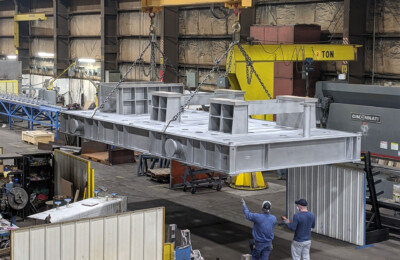
- Over 200,000 sq. ft. of manufacturing space for weldments up to and over 60 ft. long and weighing up to 160,000 lbs
- ISO 9001:2015 certification by NQA and ITAR registration with the State Department’s Directorate of Defense Trade Controls
A buyer can check a NAVSEA MIL-STD-248 fabricator against each job through procedure approvals, welder records, acceptance criteria, and joint records. Raising these questions before production welding gives the buyer time to close any qualification gaps.
Custom Engineering holds NAVSEA welding certification and fabricates components for shipboard and support systems. Certified welding inspectors and welding engineers work on site at our Erie facility.
Click below for a quote and to learn more about our NAVSEA-certified welding services.